The U.S. Open’s First Lesson: Talent Wins Points—Energy Wins Tournaments
By Rich Benvin
Opening day at the U.S. Open gave us a reminder that tennis can change in a single afternoon.
Novak Djokovic is out.
Mariano Navone defeated him 7-6, 5-7, 4-6, 6-2, 6-1 in a five-set match that became increasingly physical. Djokovic reportedly dealt with illness, vomiting, and shoulder and back problems. After taking a two-sets-to-one lead, he won only three games across the final two sets.
It is Djokovic’s earliest Grand Slam exit in more than two decades. His pursuit of a record 25th major will have to wait.
But the result was not simply an upset. It was a lesson about age, endurance, decision-making, and the changing definition of greatness.
Djokovic Had Enough Tennis—But Not Enough Reserve
Djokovic could still produce championship-level tennis. He proved that by recovering from the first-set loss and taking control of the match.
The problem was sustaining it.
At 39, the central question is no longer whether Djokovic can compete with the world’s best for a set, two sets, or even several hours. We already know he can.
The question is whether his body can repeatedly support that level across five sets, seven matches, and two demanding weeks.
“At 39, the question is no longer whether Djokovic can play championship tennis. It is whether his body can repeatedly support championship tennis.”
That is a completely different challenge.
Younger players often spend energy without thinking about it. Their recovery systems can cover tactical mistakes, emotional swings, unnecessarily long rallies, and poor positioning.
Older players must operate with greater precision. Every extended exchange has a cost. Every difficult service game draws from a more limited reserve. Every unnecessary sprint may affect decisions two games later.
Djokovic still possesses the technique, intelligence, anticipation, and competitive instincts of a champion. But even the greatest tactical mind in tennis cannot completely negotiate with fatigue, illness, or physical breakdown.
Fatigue First Appears in the Decisions
As a player and coach, I have learned that fitness deterioration does not always look like obvious exhaustion.
It often appears first as decision deterioration.
When the body begins to fade:
- Footwork becomes a fraction late.
- Players rush their shot selection.
- Safe targets suddenly feel too demanding.
- Margins become smaller.
- Emotional control becomes harder.
- The athlete tries to end points before the right opportunity arrives.
Spectators describe this as “playing badly.” But frequently, the player is no longer physically able to afford the preferred tactical decision.
A patient crosscourt exchange requires legs. Defending one additional ball requires belief in your recovery. Moving forward at the right moment requires balance, confidence, and explosive footwork.
When those physical resources disappear, the tactical menu becomes smaller.
That is why fitness and strategy cannot be separated. Energy management is strategy.
Navone deserves enormous credit because he stayed in the match long enough to expose that reality. He did not panic after falling behind. He continued making Djokovic work, forced him to solve physical problems as well as tennis problems, and became stronger as the match progressed.
The final two sets were not merely about execution. They were about available energy.
The Draw Opens for Alcaraz—But His Mindset Must Stay Small
Carlos Alcaraz begins his tournament against Roman Safiullin while returning from the wrist problem that kept him out of Roland Garros and Wimbledon.
Djokovic’s elimination dramatically changes Alcaraz’s half of the draw. Players, coaches, fans, and commentators will immediately begin recalculating his path to the final.
Alcaraz cannot afford to do that.
The most dangerous thought after a major rival disappears is:
“The tournament has opened up for me.”
A draw may open on paper, but it does not win a single point for you.
Alcaraz’s entire tournament should temporarily shrink to one assignment: solve Safiullin.
Safiullin has beaten him on hard courts before. He can strike through the court, take time away, and punish a player who is tentative or still searching for confidence in his body.
Alcaraz does not need to prove that he is ready to win the U.S. Open today. He needs to establish a few reliable patterns, trust his wrist under pressure, compete intelligently, and remain emotionally present.
The best comeback mindset is simple:
- No tournament projections.
- No title expectations.
- No comparison with peak form.
- No concern about who has already lost.
- Just pattern execution.
“The draw can open. You still have to walk through it one match at a time.”
That principle applies at every level of tennis. Looking too far ahead takes the mind away from the only problem a player can actually solve: the next point.
Venus Williams and the Changing Definition of Success
Sofia Kenin defeated Venus Williams 6-2, 7-6 in another significant opening-round match.
If we evaluate Venus only through the scoreboard, we miss the larger meaning of what she continues to represent.
At 25, elite sporting success is primarily measured through titles, rankings, and victories.
At 45 and beyond, success can also mean remaining capable of competing on the same court as the world’s best.
That is not sentimentality. It is physiology.
Venus has lived through multiple generations of professional tennis. She competed against players whose careers are now history, influenced champions who grew up watching her, and remains capable of producing a competitive Grand Slam set against a former major winner.
The remarkable part is not that Venus lost.
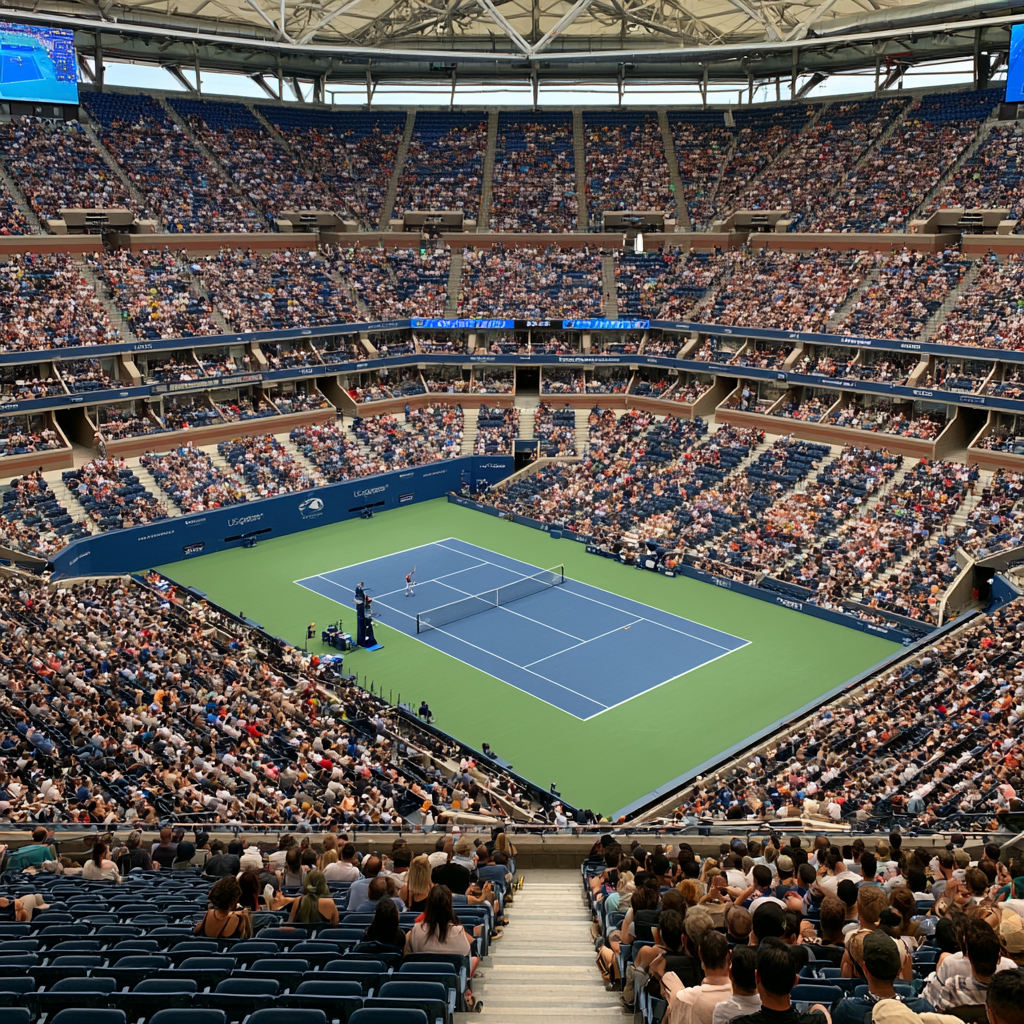
The remarkable part is that, decades into her professional career, she can still step inside Arthur Ashe Stadium and make an accomplished opponent earn the victory.
Her presence connects different eras of tennis. It reminds younger players where the modern power game came from, while showing older athletes that longevity itself can be a meaningful form of excellence.
Winning remains important. But sport is also about courage, identity, reinvention, and the willingness to continue testing yourself when the easier choice would be to protect your legacy from another loss.
Venus has never needed to protect hers.
More Than an Opening-Day Upset
The U.S. Open has already given us three powerful stories.
Djokovic showed that greatness cannot permanently outrun physical reality.
Alcaraz now faces the mental challenge of ignoring an opportunity that suddenly looks larger.
Venus reminded us that an athlete’s cultural impact cannot always be measured by the final score.
Learner Tien, Ben Shelton, Rafael Jodar, and the next generation will now step into the spotlight. Some will arrive with fresher bodies. Others will bring fearless tennis and little concern for established reputations.
That is the natural cycle of the sport.
Tennis is always moving forward, but it carries its history onto the court. We see it in Djokovic’s pursuit of one more record, Venus’s extraordinary longevity, and Alcaraz’s attempt to return healthy and reclaim momentum.
Opening day reminded us that a major championship is not won by reputation, projections, or even pure shot-making.
It is won by managing the body, controlling the mind, solving the opponent, and preserving enough energy to do it again tomorrow.
“Talent may determine how brilliantly you can play. Energy determines how long you can keep making the right decisions.”

Rich Benvin
Big Tennis contributor. Founder Rich Benvin is a former ATP pro, WTA coach and CEO of Mass Density, Inc. About Big Tennis →
Enjoyed this? Get the weekly Big Tennis recap.
Free weekly tennis news, coaching tips, drills and games — plus Teo Davidov updates. Pick what you want; unsubscribe anytime.